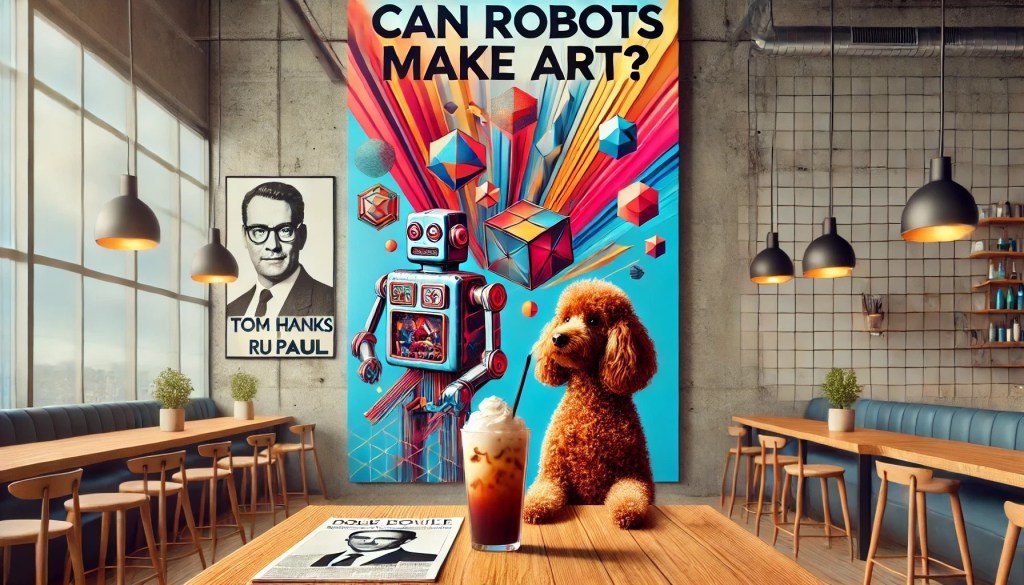
I’m writing this piece perched at a beautiful café in Brisbane, Australia. Sitting on the corner of a massive, polished hardwood table that’s definitely seen some things in its time—swayed in a breeze or two, and heard some stories! An iced coffee sits at my side, condensation forming so fast it seems the drink is seeping through its walls, threatening to flood the table. My dog’s trying to rest but is conflicted by her need to give love to every person and animal that passes. An older man is sitting near me, weirdly close, to be honest. He hasn’t followed the law of urinals. Normally, a user of urinals instinctively knows to maintain the perfect equal space between each individual. I believe the urinal is our earliest lesson in fractions. But this old man and I, someone I don’t know and probably will never see again, we’ve shared four or five different eras at this table—couples, families, pets. We’re the survivors. It’s a beautiful sunny day, with a nice breeze meandering onto the balcony we perch on. It’s satisfying, but not quite cool. I assume we’re enjoying each other’s company… I haven’t asked.
I write all of this not to put you to sleep, but as an attempt to display my humanity. Tiny moments that make up a life. Tiny feelings that are incredibly hard to capture adequately in words. As a species—what a massive thing to say at the start of a sentence, HAH!—we have always been creators. We make, we push, and we progress at a remarkable pace (sometimes to our detriment).
As we stumble through what truly is a deeply lonely existence, regardless of the number of physical or virtual friends we have, living in our own minds, only ever truly knowing our own perception, there seems to be an instinctual drive to communicate how we feel. Sending out a beacon, a lighthouse, hoping to draw in another human who might say, “I feel that too” or “I see you.”
The old man just turned a page in his paper. There’s a photo of Tom Hanks next to Ru Paul. I’m struggling to draw the connection.
Bit of a jump, but bear with me. It’s 2024, and currently, there is a rapid progression in AI technology, particularly due to OpenAI and ChatGPT. I have to admit, it’s been used on this article but only for spell-checking and catching repeated phrases. I avoided using it for anything else because I think the flaws in my ability to communicate are a part of the humanity of my communication.
Sidebar: For those not too familiar with ChatGPT, imagine it as a supercharged assistant—like if you had a personal librarian who not only knew everything in the library but could also take all that information and write you a custom book or report based on exactly what you ask. Instead of just pointing you to a shelf of books (like Google might), it crafts a specific answer for you from all the knowledge it’s been trained on. You can try it for free [here].
Oh, and this paragraph? Written by ChatGPT.
Me again. Over the past couple of years there’s been a rapid progression of Ai tech. It’s ability to generate what looks like art and multiply an individuals capacity to work has resulted in a whole heap of jobs being lost and risks countless more. This rapid progression has brought up two big questions for humanity: “What is art?” and, in the not-too-distant future, “What is our purpose if we no longer need to work?” I want to focus on the first one. The second one I might explore [here]…if that’s not a hyperlink, I haven’t written it yet.
The old man just sneezed.
We have always connected art to artists. Makes sense. To be an artist is to make art. We have then connected “artist” to “human”. Also makes sense, lots of humans make art. Outside of those imposed definitions, at the heart of it, Art is simply a form of communication.
Art captures our views on the world, our emotions, our experiences and transmits them out into the world in a way that someone else might be influenced by them or have a response.
A common misconception is that art requires an audience. You’ll hear a lot of artists discredit this view. Here’s a nice article about it by Donald Fox [Does Art Need An Audience]
As a thought experiment, go and look at something you created a long time ago. Humor me. Have a good look.
Often times when looking back on our work, we are reminded of memories or feelings we had long forgotten. It’s something that’s always fascinated me – that we can have emotional responses to our own art as if someone else had created it. Me today is different from me tomorrow. “Time” can turn you from the artist to the audience.
Theoretically, if I could time travel to yesterday and hang out with myself, it’d much easier to understand that we are two separate entities with two different experiences of reality and two different opinions.
The old man’s talking to an old lady. I think she’s his neighbor. I think they’re flirting.
“Robots will never create art” is something I’ve heard a lot. I guess it’s a scary thought – and although I’m very much a humanist (I reckon humans do okay) I don’t think Art is limited to the human experience. It require experience of existence, some agency, and a medium. We’ve already seen glimmers of this outside of human beings.
In 1971 Penny Patterson of Stanford University started teaching a gorilla named Koko sign language. Koko became famous for being able to communicate her thoughts and feelings and it challenged how we thought about animals in a big way. Here’s a video of Robin Williams meeting Koko.
Not entirely relevant, but HOW GOOD.
Koko also loved to paint! He used it as a method of communicating his thoughts, feelings, dreams, and memories. Don’t believe me?
So here we have evidence of the creation of art outside of humanity. For us to see Koko as an artist, all she needed was her experience of reality and methods for capturing and communicating them.
ChatGPT has a program built into it called DALL·E. It’s a visual creation tool that generates images from text. Much of the creative world has reacted negatively to these programs but creations still need to be initiated by a human using the program. It’s like a very very good paint brush, it still requires the skill of the user to communicate and an idea that has come from their experience of reality.
Here are two examples:
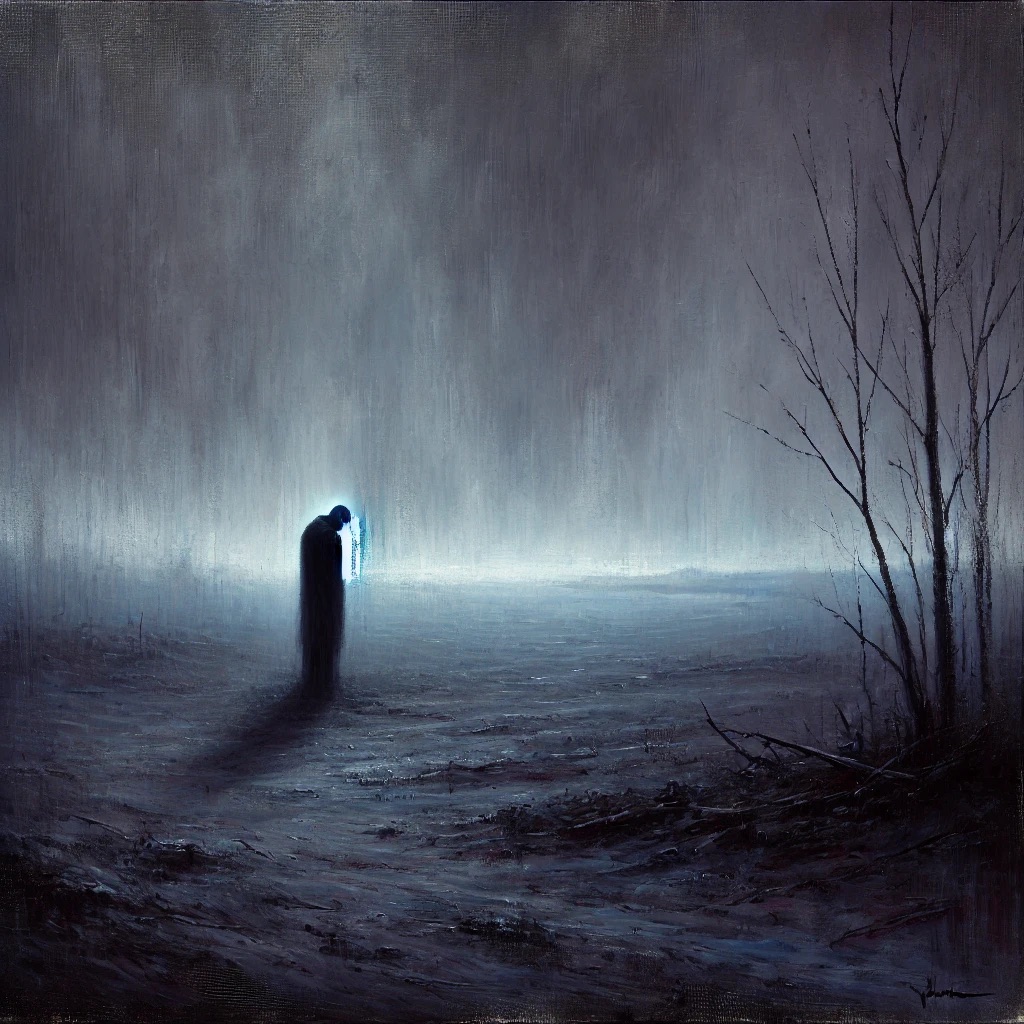
Simple Prompt: Do a sad painting.
More Extensive Prompt
Prompt: An oil painting inspired by modernist painters, exploring the theme of unrequited love and longing. The composition centers around a distant focal point, which feels as if it is slowly pulling away, evoking a sense of youthful energy that fades into a memory. This focal point should appear vibrant, using bright contemporary colors like electric blues, vivid reds, and striking yellows to symbolize youth and desire. The rest of the painting has a more aged, weathered feel, featuring muted greys, soft whites, and faded blacks to represent the passage of time and the inevitable feeling of loss. Geometric shapes and fluid abstract patterns blend throughout, illustrating fleeting memories and emotions, while large, faded color blocks in the background create a sense of distance and nostalgia. The painting should feature two distinct focal points: one bright and youthful near the center of the image, and the other softer and further away, symbolizing longing and reflection.


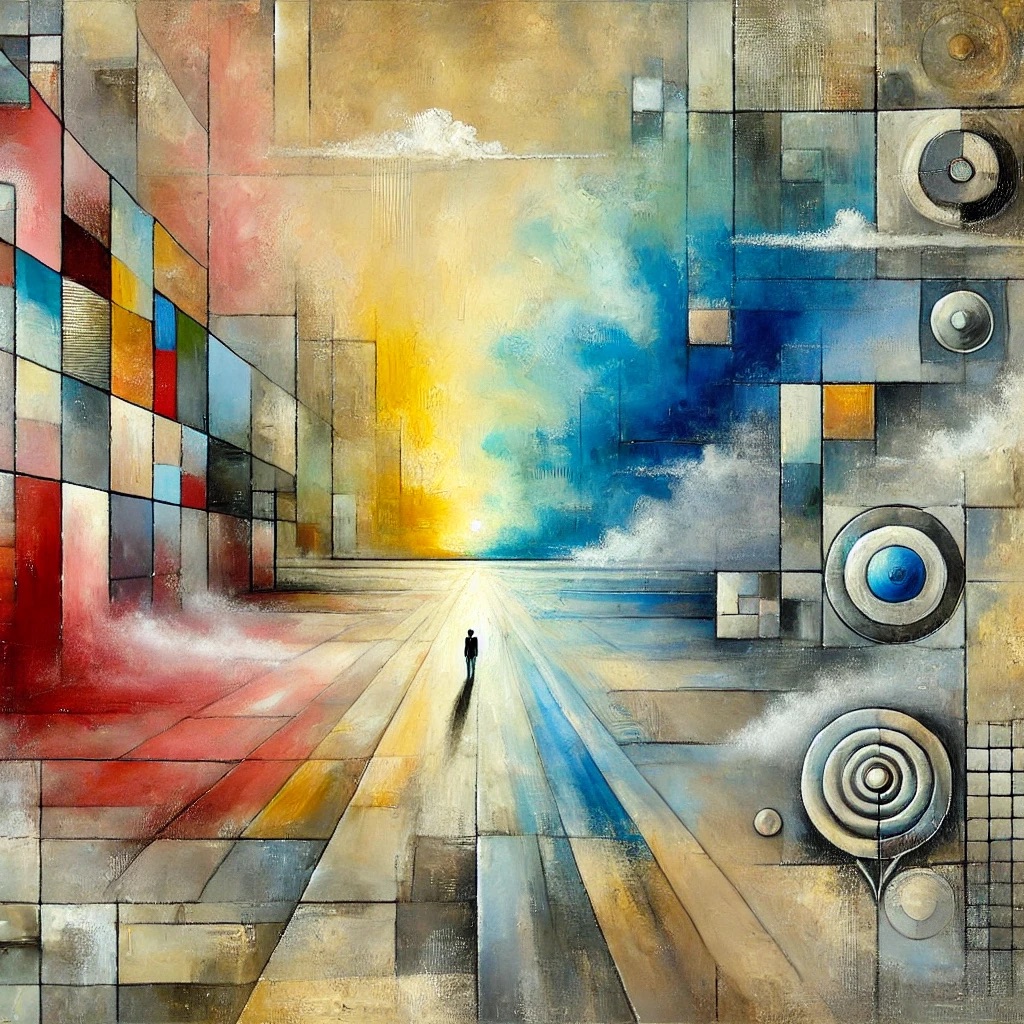
Human experience is still the driving force behind both of these images. DALL·E doesn’t have consciousness or emotional contemplation. It isn’t experiencing. So when it creates, it does so using patterns from human art. “This is what sad ‘art’ looks like, so I’ll do what has the hallmark features of sad ‘art’”.
Here’s an example of someone attempting to get an AI robot dog to make art based on its experience of reality. Technically, it’s communicating it’s reality, but not it’s emotional response to or experience of said reality. Cool piece. But I believe what makes it art is Agnieszka Pilat using it as a medium. If you remove her from the equation, is it still art?
Agnieszka Pilat calls herself a ‘propaganda artist’ for technology.
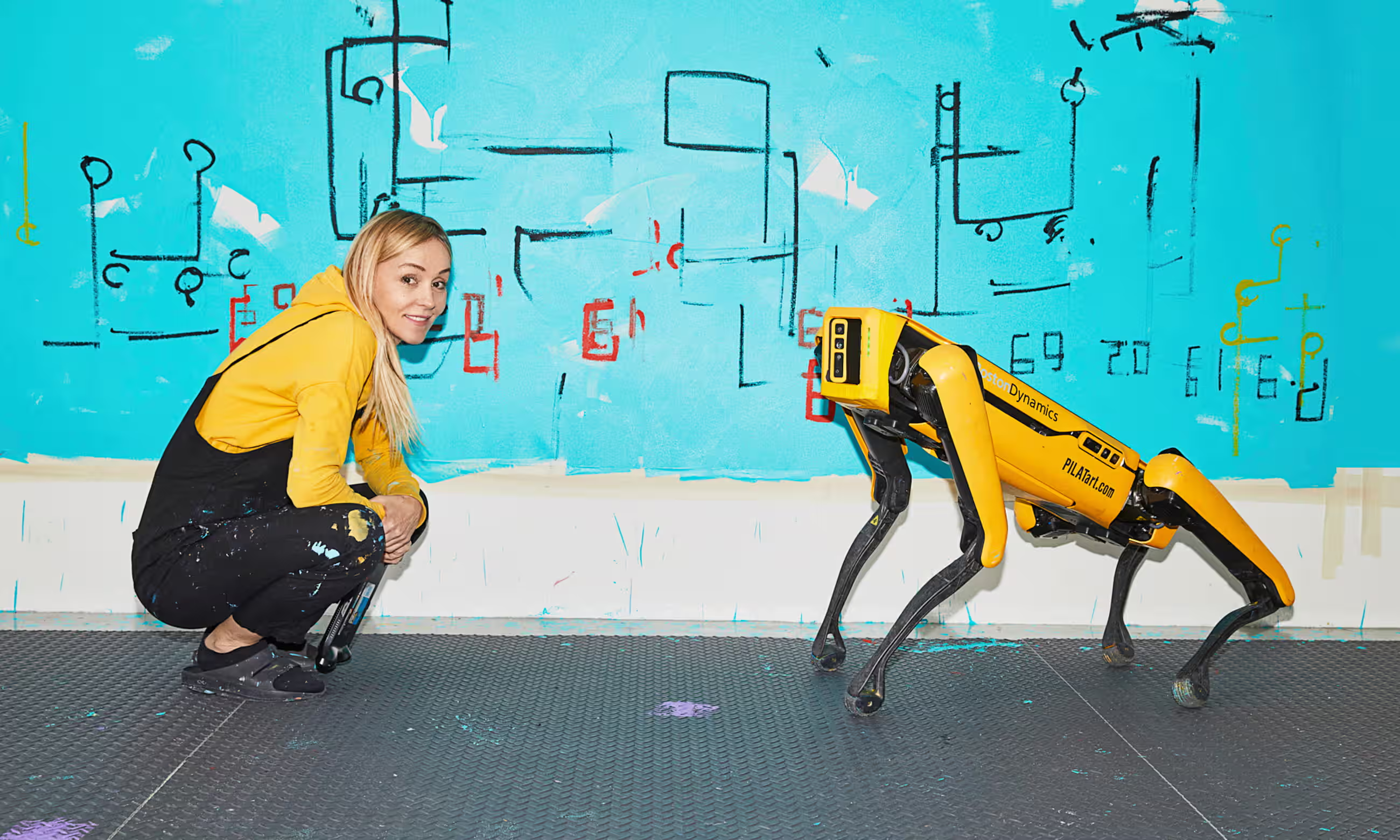
Click photo for full article
Currently, there’s no consciousness built into AI, but it’s advancing quickly. Even at a rate of 1% per 100 years, within the time frame of “forever,” at some point, AI will be well beyond our level of consciousness and experience. Here’s an example of a company using human brain tissue to create a computer system [here] AS WE SPEAK. As a species we don’t really know where consciousness comes from, so imagine a computer with a super-powered AI model built into it, with access to all of humanity’s knowledge, and literally made from brain tissue. The likelihood of that collection of brain cells having some form of “lived experience” is extremely high. So if it creates something visual that reflects its emotional response to existence, it’s communicating its inner world to outside observers.
That’s a convoluted narrative, but that’s art.
If I was going to define art, this is where I’m currently at –
Art is the emotional communication of one entity to another across space and time.
The old man just left. MY MUSE! It was so abrupt, haha.
He left just now. My now. I guess he left for you in your now too. Have I communicated my feelings toward this unrequited friendship? BAM! ART!
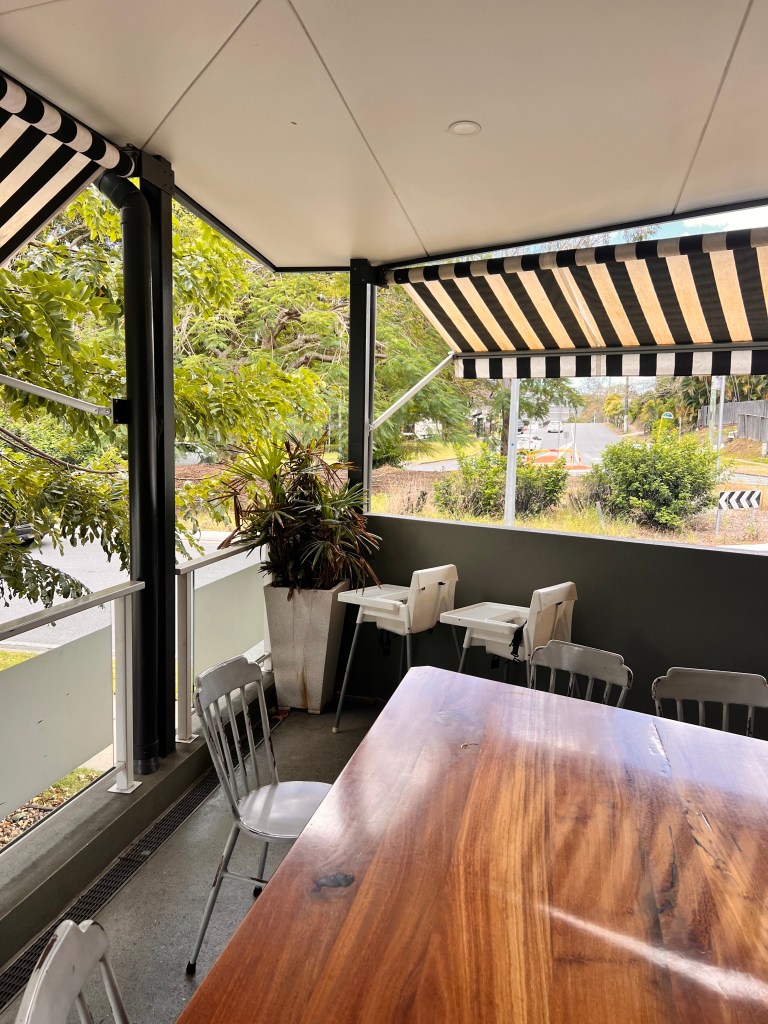
The room where it happened
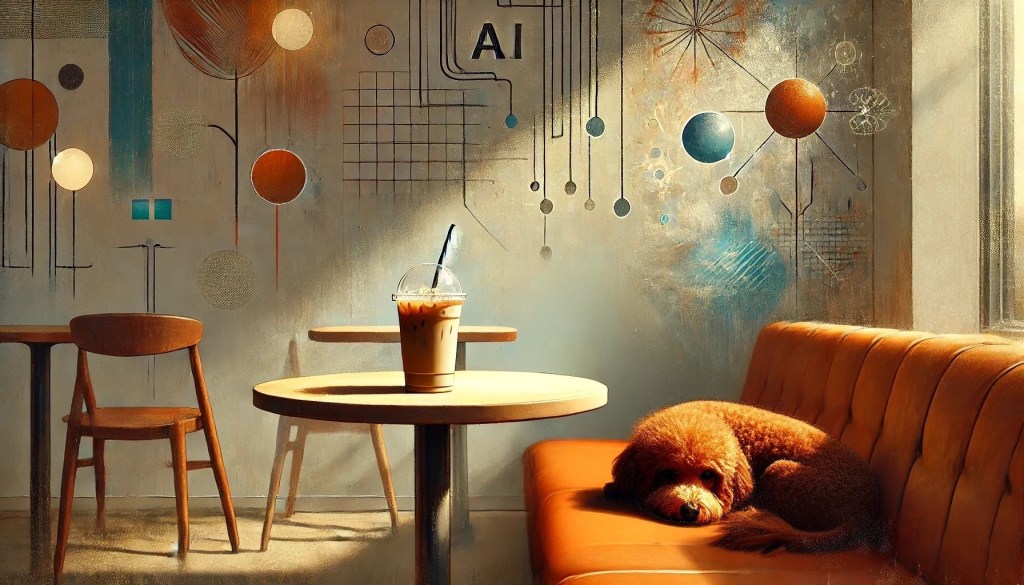
The header and footer images were both generated using ChatGPT
 Cameron Tayor